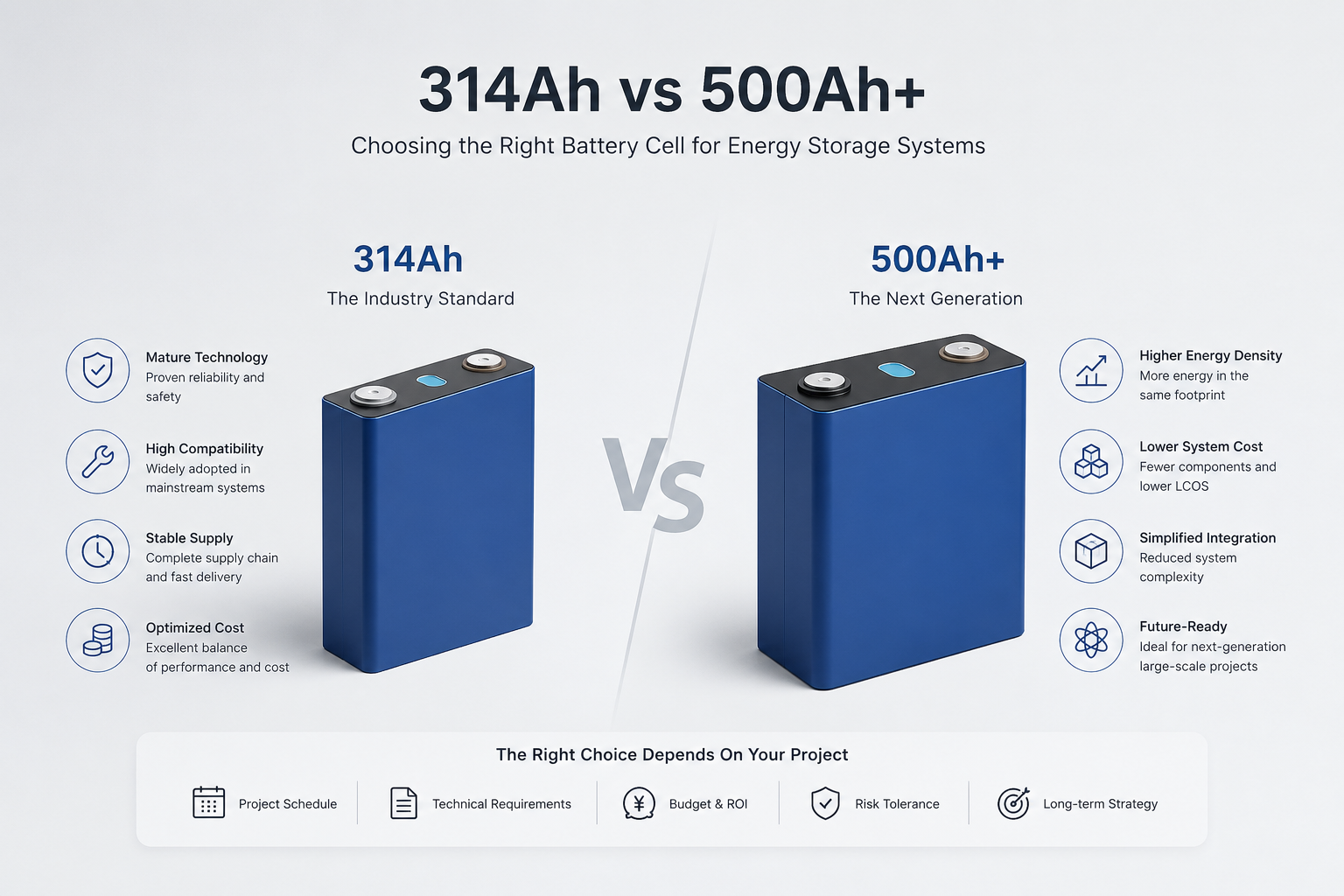
As the Battery Energy Storage System (BESS) industry continues to evolve, battery cell technology is rapidly moving toward higher capacities and lower system costs. Over the past few years, the market has shifted from 280Ah cells to 314Ah cells, while a new generation of 500Ah+ cells is beginning to enter large-scale commercial deployment.
For project developers, EPC contractors, distributors, and investors, one common question remains:
Which battery cell is the right choice for today’s energy storage projects?
At Vansenergy, we work closely with leading battery manufacturers and system integrators. Based on current industry trends and practical project experience, here’s our perspective.
The Evolution of ESS Battery Cells
The development of lithium iron phosphate (LiFePO4) battery cells has followed a clear path:
- 280Ah – First-generation mainstream ESS cell
- 314Ah – Current industry standard
- 500Ah+ – Next-generation high-capacity platform
Each generation aims to reduce system cost while increasing energy density and simplifying system integration.
However, newer doesn’t always mean better for every project.
The optimal solution depends on project schedule, investment strategy, certification requirements, and long-term operational goals.
Why 314Ah Has Become the Industry Standard
Today, 314Ah LiFePO4 cells have become the preferred choice for most commercial and utility-scale energy storage projects.
Several factors explain why.
Mature Supply Chain
Leading manufacturers including CATL, EVE Energy, REPT Battero, Hithium, BYD, and CALB have established large-scale production capacity for 314Ah cells.
This results in:
- Stable production
- Competitive pricing
- Short delivery lead times
- Proven manufacturing quality
For project developers, supply chain reliability is often more valuable than adopting the newest technology.
Excellent Balance Between Performance and Cost
314Ah cells offer an excellent balance of:
- High energy density
- Long cycle life (typically 8,000+ cycles depending on operating conditions)
- Mature thermal management
- Proven safety performance
- Optimized pack design
These advantages make them ideal for residential, commercial & industrial (C&I), and utility-scale BESS applications.
Proven in Real Projects
Unlike emerging technologies, 314Ah battery systems have already accumulated significant operational experience worldwide.
System integrators have optimized:
- Battery pack structures
- BMS algorithms
- Thermal management
- Fire suppression systems
- Certification processes
This greatly reduces technical risk during project execution.
The Rise of 500Ah+ Battery Cells
The next generation of ESS cells is entering the market.
Major manufacturers have introduced products ranging from approximately 560Ah to over 600Ah, enabling significantly larger energy storage systems within the same container footprint.
Higher-capacity cells bring several advantages.
Higher System Energy Density
Fewer battery cells are required to achieve the same energy capacity.
This reduces:
- Module quantity
- Busbar connections
- Mechanical components
- Assembly complexity
The result is higher energy density and potentially lower manufacturing costs.
Lower Levelized Cost of Storage (LCOS)
With fewer components throughout the battery system, developers may benefit from:
- Lower installation costs
- Reduced maintenance requirements
- Simplified electrical architecture
- Better utilization of container space
For very large utility-scale projects, these savings become increasingly significant.
Designed for Next-Generation Utility Projects
Many new 20-foot energy storage containers are already moving toward capacities exceeding 6MWh.
Such systems are difficult to achieve efficiently with previous-generation battery cells.
Large-capacity cells make these ultra-high-energy-density systems possible.
Challenges of 500Ah+ Technology
Although promising, higher-capacity battery cells are still in the early stage of market adoption.
Several challenges remain.
Industry Standards Are Still Evolving
Different manufacturers currently use different cell dimensions and structural designs.
This creates compatibility challenges for:
- Battery pack design
- Automated production
- Maintenance
- Spare parts management
The market has not yet reached complete standardization.
Certification and Long-Term Validation
As with every new technology platform, extensive field validation takes time.
Developers should carefully evaluate:
- Safety certifications
- Third-party testing reports
- Mass-production consistency
- Long-term operational data
Especially for large infrastructure projects, proven reliability remains critical.
Which Battery Cell Should You Choose?
Rather than asking which battery cell is “best,” a better question is:
Which battery cell is best for your project?
Choose 314Ah if:
- Your project requires proven technology.
- Delivery schedule is critical.
- You need mature certifications.
- Long-term reliability is the highest priority.
- You are building residential, C&I, or today’s utility-scale ESS projects.
Consider 500Ah+ if:
- You are planning next-generation utility-scale projects.
- Maximum energy density is a key objective.
- Your project timeline allows adoption of emerging technologies.
- You are prepared to work with evolving system platforms.
The Vansenergy Approach
At Vansenergy, we do not lock customers into a single battery cell platform.
Instead, we design complete energy storage solutions based on each project’s technical and commercial requirements.
Our integrated ESS solutions support multiple battery technologies from leading manufacturers, allowing customers to balance:
- Project budget
- Delivery schedule
- Performance targets
- Local certification requirements
- Long-term operational costs
Whether your project requires a residential battery system, a commercial & industrial ESS cabinet, or a utility-scale containerized energy storage system, we help identify the most suitable battery platform rather than simply recommending the newest one.
Looking Ahead
Battery cell technology will continue to evolve toward larger capacities, higher safety, and lower system costs.
While 500Ah+ platforms represent the future direction of large-scale energy storage, 314Ah remains the most mature and widely adopted solution in today’s market.
Successful projects are built not by choosing the largest battery cell, but by selecting the right technology for the right application.
As an integrated PV and energy storage solution provider, Vansenergy continues to monitor industry developments and work with leading battery manufacturers to deliver reliable, scalable, and future-ready energy storage systems for customers worldwide.
Interested in discussing your next ESS project? Contact Vansenergy to explore the most suitable battery technology and complete PV + BESS solution for your application.