As energy storage adoption grows across residential and C&I applications, one question comes up frequently:
Should the system be AC-coupled or DC-coupled?
There is no universal answer.
Each architecture has its strengths, and the right choice depends on application scenarios, existing infrastructure, and long-term objectives.
AC-Coupled ESS
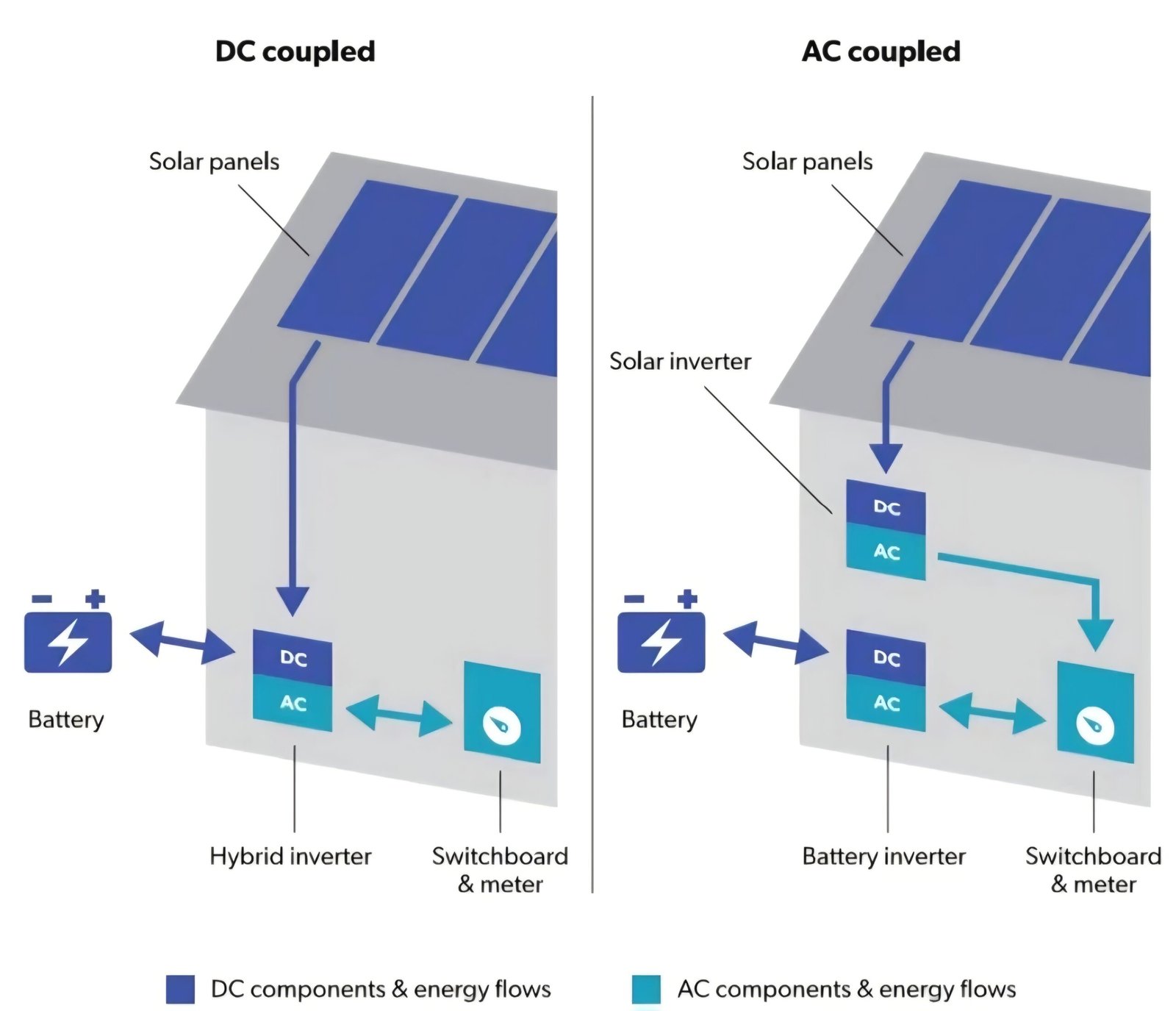
In an AC-coupled system, the solar PV system and the battery storage system are connected on the AC side, each with its own inverter.
Key characteristics:
• PV and battery inverters operate independently
• High flexibility for retrofitting existing PV systems
• Easier system expansion or component replacement
• Common in residential and C&I retrofit projects
Advantages:
✔ High flexibility
✔ Ideal for existing PV installations
✔ Easier multi-vendor integration
Considerations:
• Additional power conversion steps
• Slightly lower round-trip efficiency than DC-coupled systems
DC-Coupled ESS
In a DC-coupled system, solar PV and battery storage share the same DC bus, typically connected to a hybrid inverter or PCS.
Key characteristics:
• PV generation can charge batteries directly on the DC side
• Fewer conversion stages and higher efficiency
• More compact system architecture
• Common in new-build projects
Advantages:
✔ Higher overall efficiency
✔ Lower conversion losses
Considerations:
• Less flexible for retrofits
• Expansion may require inverter replacement
• Higher upfront system design requirements
Residential Applications
• New solar + storage installations → DC-coupled is often preferred
• Storage retrofits for existing PV → AC-coupled offers more flexibility
Reliability, safety, and ease of maintenance remain as important as efficiency.
C&I Applications
For commercial and industrial users, the decision is rarely based on coupling type alone.
Key factors include:
• Load profile and demand charge structure
• Peak shaving and energy shifting strategy
• Grid requirements and compliance
• System scalability and lifecycle cost
Depending on the application, AC-coupled systems may offer flexibility, while DC-coupled systems may deliver higher efficiency and control.
Our View at Vansenergy
At Vansenergy, we don’t start projects by choosing AC or DC coupling.
We start with energy behavior, grid requirements, lifecycle performance, and future expansion.
Both AC-coupled and DC-coupled ESS are proven architectures.
The right solution is always the one that fits the application — not the technology trend.
Final Thought
Energy storage is not a standardized product.
It is a system — and system design defines long-term performance, safety, and returns.
Choosing between AC-coupled and DC-coupled ESS is not about which is “better,”
but about which is better suited to your specific needs.