
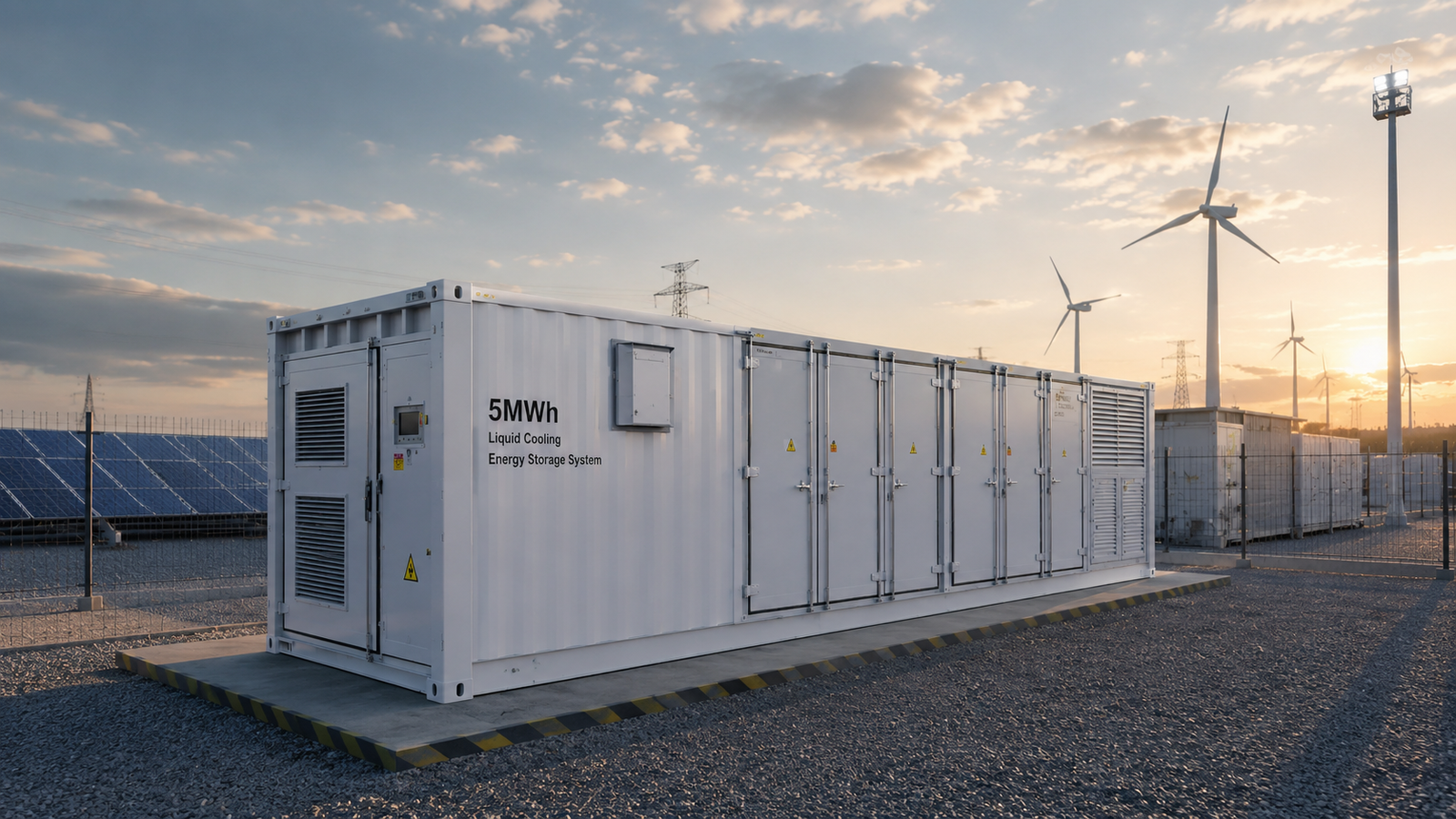
As global renewable energy penetration hits historic highs, the Battery Energy Storage System (BESS) market is transitioning. In the utility-scale sector, evaluations are shifting from upfront capital expenditures to system longevity, safety, and grid-interaction capabilities. For global renewable energy project developers and EPC contractors, evaluating core technology requires a focus on three pivotal technical milestones reshaping industry standards.
1. Capacity Leap: 314Ah+ Cells and 5MWh+ Liquid-Cooled Containers
In major utility-scale procurement tenders, 314Ah high-capacity cells paired with 20-foot 5MWh+ liquid-cooled storage containers have established market dominance.
- The Economics of High Integration: A 5MWh+ container increases energy density, reducing the overall footprint of a storage power plant by 20% to 30% while cutting on-site installation and cabling workloads by over 15%. In markets where land or construction costs are high, this advancement reduces the Balance of System (BOS) cost by nearly 10%.
- The Thermal Runaway Challenge: Increased energy density demands strict safety measures. Larger 314Ah cells exhibit highly concentrated heat generation. Advanced systems adopt PACK-level Perfluorohexanone (FK-5-1-12) fire suppression combined with water-spraying dual-protection systems, ensuring that a thermal runaway event within a single PACK is isolated from spreading to adjacent units.
2. Precision Thermal Management: Liquid-Cooling Iteration for LCOS
Because utility-scale projects are built for a 15-to-20-year operational lifespan, every 1°C increase in cell temperature or uneven temperature distribution causes exponential degradation in battery life.
The current industry-vanguard technologies focus on:
- Cell-to-Cell Temperature Difference Under 2.5°C: Optimized flow-channel designs and intelligent control algorithms maintain the temperature variance among thousands of cells inside a 20-foot container within a narrow margin. This prevents premature State of Health (SOH) imbalance and lowers the Levelized Cost of Storage (LCOS).
- Smart Frequency Conversion & Predictive Cooling: Advanced systems integrate BMS data with localized weather forecasting to proactively cool or preheat batteries. This minimizes parasitic loads and ensures the Round-Trip Efficiency (RTE) consistently stays above 85%.
3. Shifting from “Grid-Following” to “Grid-Forming”
This represents the software and control frontier in utility-scale BESS evolution. Traditional storage inverters (PCS) are predominantly “Grid-Following,” meaning they rely on existing voltage and frequency signals from the macro-grid to operate. However, as volatile wind and solar assets displace traditional thermal power plants, the grid itself becomes unstable.
- Grid-Forming Control: This transforms a BESS into a “Virtual Synchronous Machine.” Grid-forming energy storage actively establishes stable voltage and frequency. In the event of a transient grid fault, sudden voltage drop, or frequency plunge, it responds within milliseconds (ms) to inject critical inertia and short-circuit capacity, acting as a structural anchor for the local grid.
- The Market Mandate: Grid operators worldwide—including AEMO in Australia, the National Grid in the UK, and various ISOs in the United States—have begun mandating Grid-Forming capabilities or offering premium tariff structures for compliant projects. Integrators with proven hardware-software synergy in grid-forming control possess a competitive edge in securing international pipelines.
Summary
Utility-scale BESS procurement has evolved from purchasing hardware to securing engineered assets evaluated on lifetime financial performance. When choosing a vendor, project stakeholders must look beyond the initial capital expenditure ($/Wh) and audit integrated thermal design, PACK-level safety architecture, and advanced PCS control algorithms. Brands like Vansenergy, which dedicate R&D to high-standard safety integration and grid-friendly capabilities, empower asset owners to achieve zero catastrophic incidents and maximized asset yield across a 20-year lifespan.