
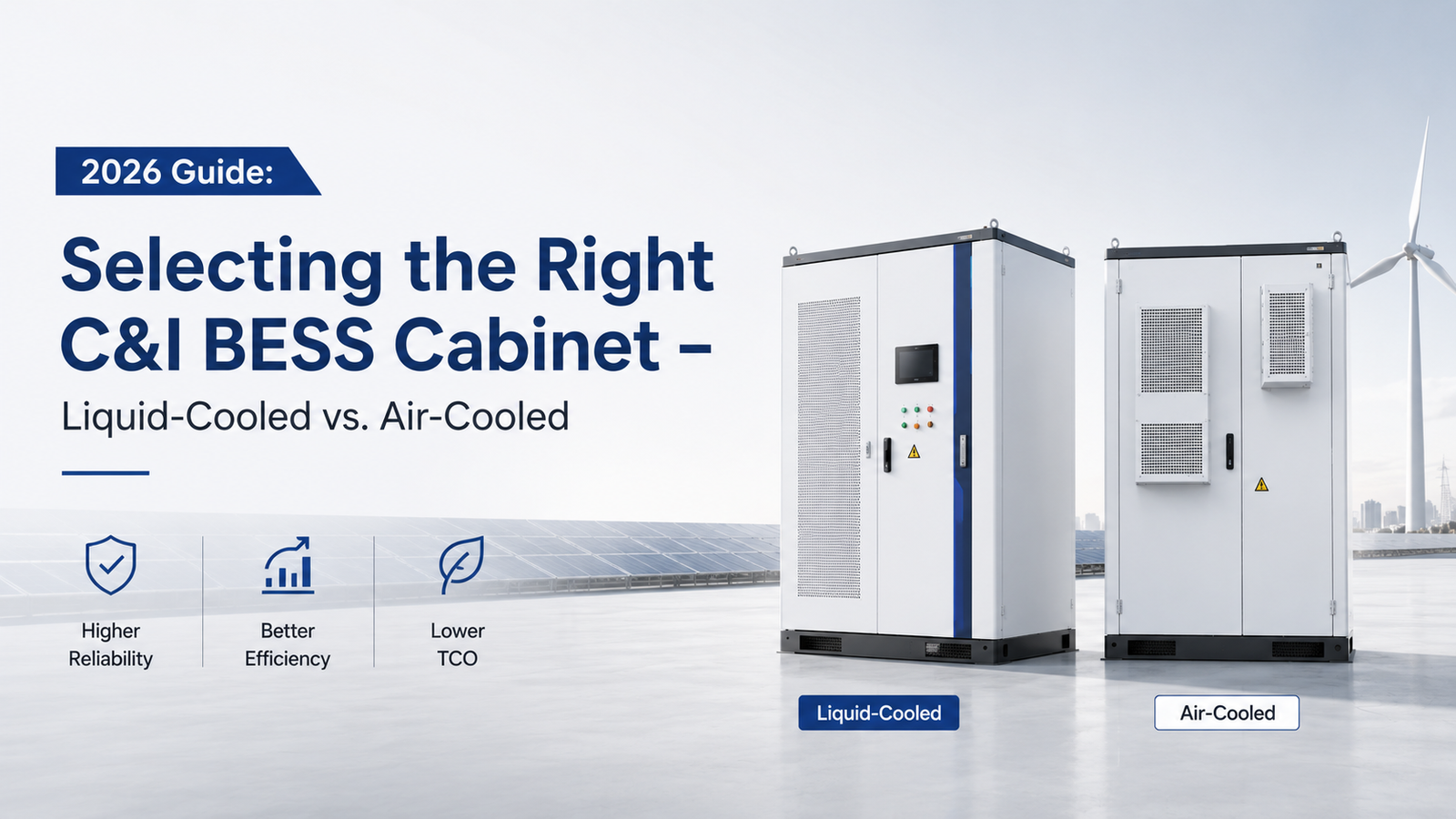
In 2026, Commercial and Industrial (C&I) energy storage is no longer a one-size-fits-all market. For EPC contractors and facility managers optimizing energy assets, selecting the right Battery Energy Storage System (BESS) cabinet hinges on project-specific variables: climate, footprint constraints, and budget. Both Air-Cooled and Liquid-Cooled BESS cabinets offer powerful mechanisms for peak shaving, demand charge management, and solar optimization. The key is applying first-principles engineering to match the thermal management technology with the project’s exact operational requirements.
What is an All-in-One C&I BESS Cabinet?
An all-in-one BESS cabinet is a pre-engineered, modular energy asset. Modern cabinets securely house the lithium battery packs, Power Conversion System (PCS), Battery Management System (BMS), Energy Management System (EMS), and fire suppression within a single outdoor-rated enclosure.
When configuring a system, developers must choose between two highly effective thermal management architectures: Air-Cooling (HVAC) or Liquid-Cooling.
The First Principles of Thermal Management: Air vs. Liquid
When evaluating energy storage hardware, there is no single “best” cooling method—only the most appropriate engineering solution for a specific deployment.
1. Air-Cooled BESS Cabinets: The Proven & Cost-Effective Standard
Air-cooled systems utilize industrial-grade HVAC units and optimized airflow channels to regulate battery temperatures.
- Key Advantages: This is a highly mature, heavily tested technology. The internal architecture is simpler, which drastically lowers the initial Capital Expenditure (CAPEX) of the project. Furthermore, maintenance is straightforward; replacing or servicing an HVAC unit is a standard procedure that doesn’t require specialized liquid-handling protocols.
- Best Use Cases: Ideal for moderate climates, projects with ample installation space, and standard cycling requirements (e.g., 0.5C charge/discharge rates). For facilities prioritizing a faster short-term ROI and lower upfront investment, air-cooled cabinets remain a dominant and reliable choice.
2. Liquid-Cooled BESS Cabinets: High-Density Precision
Liquid-cooled systems utilize micro-channel liquid cold plates in direct contact with battery modules to dissipate heat efficiently.
- Key Advantages: Liquid cooling offers exceptional thermal conductivity. It can maintain cell-to-cell temperature differences strictly under 2.5°C, which minimizes battery degradation over a 15-year lifecycle. Because the cooling mechanism is highly compact, these systems offer a significantly higher energy density, reducing the physical footprint of the cabinet.
- Best Use Cases: Essential for extreme climates (both high heat and freezing conditions), space-constrained commercial sites, and projects requiring continuous, high-frequency, or high-current cycling (e.g., 1C rates).
Core Revenue Streams: How C&I Facilities Generate ROI
Regardless of the cooling technology selected, deploying a high-efficiency BESS cabinet unlocks multiple revenue streams for commercial operations:
Peak Shaving (Energy Arbitrage)
The EMS automatically charges the BESS during off-peak hours when electricity prices are lowest. During peak hours, when grid tariffs spike, the facility draws power from the batteries, fundamentally lowering daily operational costs.
Demand Charge Management
Utility companies frequently charge commercial users based on their peak power draw. If a factory starts heavy machinery, the resulting power spike dictates their demand fee for the entire month. The BESS detects these spikes and instantly discharges power to “shave” the peak, drastically reducing monthly utility demand fees.
Solar Self-Consumption Optimization
For EPCs pairing storage with commercial photovoltaic (PV) arrays, the BESS prevents excess solar generation from being exported to the grid at low feed-in tariffs. It stores the green energy for use during night shifts or peak hours, maximizing the value of the PV installation.
Procurement Standards for EPC Contractors
When sourcing C&I energy storage equipment in 2026, project developers must prioritize fundamental safety and intelligent design.
A premium system—whether air-cooled or liquid-cooled—should feature:
- High Round-Trip Efficiency (RTE): Ensuring minimal energy loss during the AC-to-AC conversion cycle.
- Active Fire Suppression: PACK-level isolation utilizing clean agents (like FK-5-1-12) coupled with rigorous BMS monitoring to ensure industrial-grade safety.
- Plug-and-Play Integration: Pre-configured parameters to reduce civil works, balance of system (BOS) costs, and on-site commissioning time.
Leading brands like Vansenergy embody a “less is more” engineering philosophy. By stripping away redundant complexities and analyzing the fundamental logic of power storage, Vansenergy provides both advanced liquid-cooled and reliable air-cooled BESS solutions. This ensures EPCs and commercial users receive a tailored, minimalist, and high-performance asset perfectly aligned with their financial and operational goals.