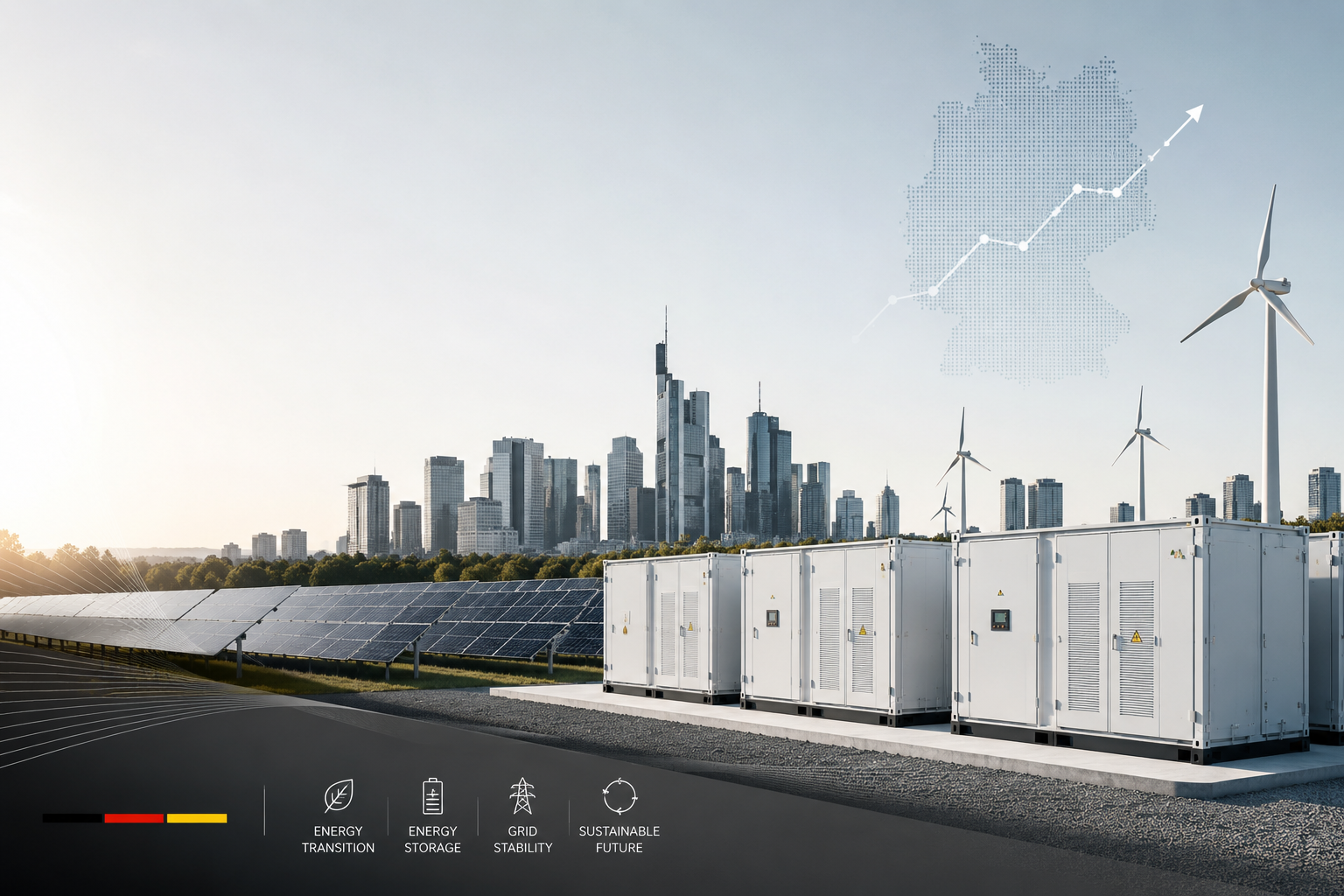
Germany has long been Europe’s largest renewable energy market, and in 2026 it continues to lead the continent’s battery energy storage deployment. Driven by rising electricity prices, ambitious renewable energy targets, and increasing demand for grid flexibility, Battery Energy Storage Systems (BESS) are becoming an essential part of Germany’s energy transition.
For manufacturers, EPC companies, distributors, and investors, Germany remains one of the most attractive energy storage markets in Europe.
In this article, we’ll explore the latest trends, growth drivers, market opportunities, and future outlook for Germany’s rapidly expanding energy storage industry.
Germany Leads Europe’s Energy Storage Expansion
Germany’s renewable energy transformation (Energiewende) has dramatically increased the share of solar and wind generation. However, renewable electricity is inherently intermittent, creating growing demand for flexible storage solutions.
Battery Energy Storage Systems help solve this challenge by:
- Storing excess solar generation during the day
- Providing electricity during peak demand
- Reducing grid congestion
- Improving power quality
- Supporting frequency regulation
- Increasing energy independence
Germany has become Europe’s largest battery storage market across residential, commercial, and utility-scale applications. Utility-scale battery deployments reached record levels in 2025 and continued accelerating into 2026 as developers increasingly pair storage with large solar projects.
Key Drivers Behind Germany’s BESS Growth
1. Rising Electricity Prices
Germany continues to experience some of Europe’s highest electricity prices.
As energy costs remain volatile, businesses are investing in battery storage to:
- Reduce electricity bills
- Perform peak shaving
- Optimize self-consumption
- Lower demand charges
For many commercial and industrial users, battery storage now delivers measurable operational savings while improving energy resilience.
2. Rapid Solar PV Expansion
Germany continues adding significant amounts of rooftop and utility-scale solar capacity every year.
As solar penetration increases, more electricity is generated during daylight hours than can be immediately consumed.
Battery storage allows this excess energy to be stored and used later, significantly improving renewable energy utilization.
3. Grid Stability Requirements
With increasing renewable penetration, Germany’s electricity grid requires more flexible resources.
Modern BESS can provide:
- Frequency regulation
- Voltage support
- Fast response reserve
- Grid balancing services
These grid services are becoming an increasingly important revenue stream for large battery projects.
4. Government Energy Transition Goals
Germany aims to generate around 80% of its electricity from renewable sources by 2030, making energy storage a critical part of future grid planning. Long-term grid development scenarios also project substantial growth in large-scale storage capacity through 2045.
Fastest Growing Market Segments
Residential Energy Storage
Germany has one of the world’s largest residential battery markets.
Homeowners increasingly combine:
- Rooftop solar
- Lithium batteries
- Hybrid inverters
- Smart energy management
Although residential installations remain the largest installed base, growth is gradually stabilizing as the market matures.
Commercial & Industrial (C&I)
The C&I segment is currently one of the fastest-growing opportunities.
Factories, warehouses, supermarkets, office buildings, and logistics centers are adopting battery storage to:
- Reduce operating costs
- Improve backup power
- Integrate rooftop PV
- Participate in energy optimization
This segment is particularly attractive because projects typically range from 50 kWh to several MWh, aligning well with integrated commercial storage solutions.
Utility-Scale Storage
Utility-scale battery storage is experiencing the strongest growth.
Developers are increasingly building large battery systems alongside solar farms to:
- Shift energy production
- Increase grid flexibility
- Participate in electricity trading
- Provide ancillary services
Large-scale installations are expected to remain the fastest-growing segment over the coming decade.
Challenges Facing the German Market
Despite its strong growth, Germany’s energy storage market also faces several challenges.
Grid Connection Delays
Obtaining grid connection approval for large battery projects can take considerable time due to network constraints.
Market Competition
The German market has become increasingly competitive, with manufacturers from Europe and Asia competing on technology, integration capability, and lifecycle cost.
Project Economics
Successful BESS projects increasingly rely on combining multiple revenue streams, including energy arbitrage, peak shaving, ancillary services, and renewable integration, rather than depending on a single application.
Opportunities for International Suppliers
Germany continues to offer significant opportunities for international battery manufacturers and system integrators.
Customers are increasingly looking for suppliers that can provide:
- Complete energy storage systems
- High-quality lithium batteries
- Integrated BMS & EMS
- Flexible customization
- Remote monitoring
- Long-term technical support
- Reliable after-sales service
Rather than purchasing individual components, many developers now prefer turnkey integrated storage solutions that simplify project delivery.
Future Outlook
Germany’s energy storage market is expected to remain one of Europe’s fastest-growing sectors over the next decade.
As renewable energy continues expanding, battery storage will become essential for improving grid stability, reducing energy costs, and maximizing clean energy utilization.
For companies entering the European market, Germany represents not only the largest battery storage opportunity today but also one of the strongest long-term growth markets worldwide.
Conclusion
Germany’s transition toward a cleaner and more resilient energy system is creating unprecedented demand for Battery Energy Storage Systems.
Whether for residential homes, commercial facilities, or utility-scale renewable projects, battery storage is becoming a core component of the country’s energy infrastructure.
For manufacturers, EPC contractors, distributors, and investors, understanding Germany’s evolving energy storage market is essential for capturing future business opportunities.