
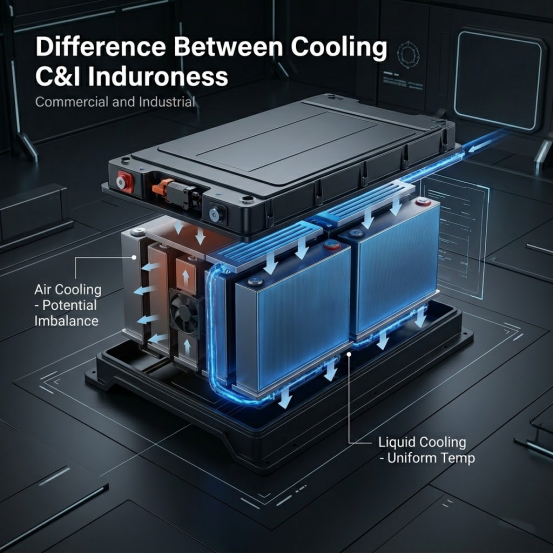
In the Commercial and Industrial (C&I) sector, the longevity of a battery system is directly tied to its thermal management. As energy densities increase with the arrival of 314Ah and 560Ah cells, traditional air cooling is reaching its physical limits. In 2026, Liquid Cooling has emerged as the definitive benchmark for high-performance Energy Storage Systems (ESS).
The primary challenge with large-scale storage is “thermal runaway” and uneven cell aging. Air cooling relies on fans and ambient air, which often leads to a temperature delta of $5^\circ C$ to $10^\circ C$ between cells at the center of a rack and those on the edge. This imbalance causes some cells to degrade faster than others, shortening the lifespan of the entire multi-million dollar investment.
Vansenergy‘s liquid-cooled solutions solve this by circulating a specialized coolant through plates in direct contact with the cells. This method keeps the temperature difference within a strict $3^\circ C$ margin. By maintaining a uniform temperature, the system ensures that all cells age at the same rate, effectively extending the project’s life by up to 20%.
Moreover, liquid cooling systems are more compact. Because liquid carries heat more efficiently than air, the physical footprint of the ESS container can be reduced by nearly 30%. For businesses with limited space, this allows for more “energy per square meter.” For Vansenergy, the transition to liquid cooling isn’t just a technical upgrade; it’s a commitment to providing the lowest possible Levelized Cost of Energy (LCOE) for our industrial partners.