
Battery consistency is one of the most important factors affecting the safety, efficiency, and lifespan of a Battery Energy Storage System (BESS).
Even when battery cells come from the same production batch, slight differences in capacity, internal resistance, and self-discharge rate gradually cause voltage imbalance over time. Without an effective Battery Management System (BMS), these differences can reduce usable capacity, accelerate battery aging, and even trigger system protection.
To solve this challenge, modern BMS solutions generally use one of two balancing methods:
- Passive Balancing
- Active Balancing
Although both aim to maintain battery consistency, they operate in fundamentally different ways.
What Is Passive Balancing?
Passive balancing is the most widely adopted balancing method in today’s lithium battery systems.
Its operating principle is straightforward:
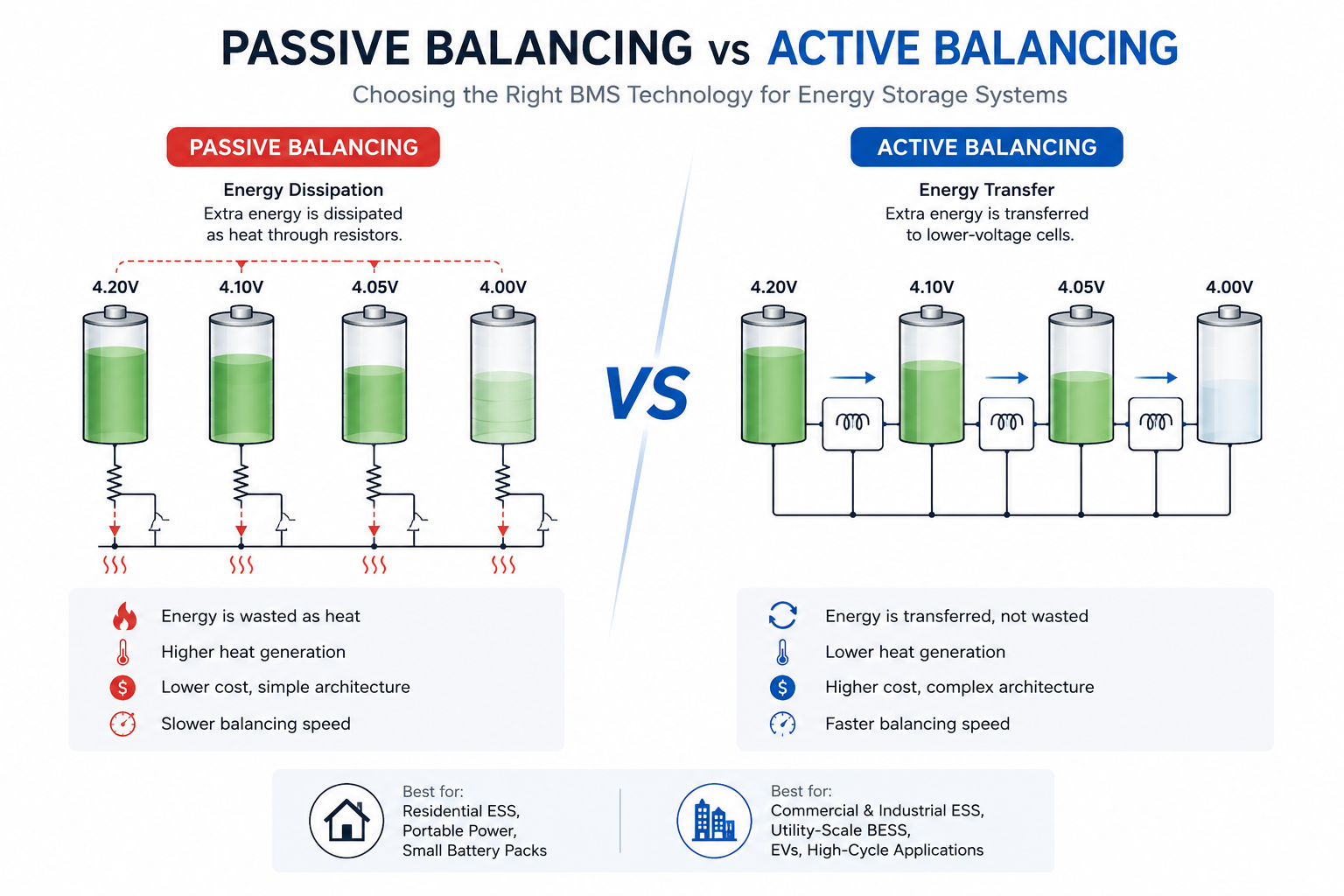
When one battery cell reaches a higher voltage than the others, the BMS discharges the excess energy through balancing resistors, converting the surplus energy into heat.
Instead of redistributing energy, passive balancing simply removes the extra charge from stronger cells until all cells reach a similar voltage level.
Because of its simple hardware architecture, passive balancing offers several advantages:
- Low hardware cost
- Simple circuit design
- High reliability
- Easy integration
However, the energy removed during balancing is permanently lost as heat, making the process relatively inefficient.
What Is Active Balancing?
Active balancing follows a completely different philosophy.
Rather than wasting excess energy, the BMS transfers energy directly from higher-voltage cells to lower-voltage cells using electronic energy transfer circuits.
Depending on system design, energy may be transferred through:
- Inductors
- Capacitors
- Transformers
- DC-DC conversion circuits
Instead of “cutting off the tallest cell,” active balancing “fills the shortest cell.”
This significantly improves overall battery utilization while reducing heat generation.
Passive Balancing vs Active Balancing
| Feature | Passive Balancing | Active Balancing |
|---|---|---|
| Working Principle | Dissipates excess energy as heat | Transfers energy between cells |
| Energy Efficiency | Lower | Higher |
| Heat Generation | Higher | Lower |
| Balancing Speed | Moderate | Faster |
| Circuit Complexity | Simple | More Complex |
| Hardware Cost | Lower | Higher |
| Operating Time | Mainly during charging | Charging, discharging and idle |
| Battery Utilization | Good | Excellent |
| Suitable Applications | Residential ESS, portable batteries, small battery packs | Commercial ESS, utility-scale BESS, EVs |
Advantages of Passive Balancing
Passive balancing remains popular because of its simplicity.
For residential energy storage systems where battery packs typically contain fewer cells and experience relatively light cycling, passive balancing often provides sufficient performance at a competitive cost.
Its advantages include:
- Lower manufacturing cost
- Mature technology
- High reliability
- Easier maintenance
- Lower software complexity
For many home battery systems, these benefits outweigh the energy lost during balancing.
Advantages of Active Balancing
As battery capacity increases, the limitations of passive balancing become more noticeable.
Commercial and utility-scale energy storage systems often contain hundreds or even thousands of battery cells. Even small differences between cells can accumulate into significant energy losses over years of operation.
Active balancing helps address these challenges by:
- Increasing usable battery capacity
- Reducing energy waste
- Lowering operating temperature
- Improving system efficiency
- Extending battery service life
- Supporting higher cycling frequency
These advantages become increasingly valuable in projects designed for daily charging and discharging over more than ten years.
Which Balancing Method Is Better?
There is no universal answer.
The optimal balancing strategy depends on the application’s technical requirements, operating profile, and total cost of ownership.
Passive Balancing is ideal when:
- Initial investment is a priority
- Battery capacity is relatively small
- Cycling frequency is moderate
- System simplicity is preferred
Typical applications include:
- Residential battery storage
- Portable power stations
- Small off-grid systems
Active Balancing is better suited for:
- Commercial & Industrial (C&I) ESS
- Utility-scale Battery Energy Storage Systems
- High-cycle applications
- Long service life requirements
- Projects focused on maximum energy efficiency
For large-scale projects, the higher upfront investment is often offset by improved battery utilization and lower lifetime operating costs.
Emerging Trend: Hybrid Balancing
An increasing number of advanced Battery Management Systems are beginning to combine both balancing methods.
In hybrid balancing architectures:
- Passive balancing may be used during charging to remove minor voltage differences.
- Active balancing can operate during charging, discharging, or standby to continuously redistribute energy.
This approach seeks to balance system cost, efficiency, and long-term reliability.
As balancing technology continues to evolve, hybrid solutions are expected to become more common in next-generation energy storage systems.
The Vansenergy Perspective
At Vansenergy, we believe that selecting the right Battery Management System is just as important as selecting high-quality battery cells.
Different applications require different balancing strategies.
Residential energy storage systems often prioritize affordability and reliability, while commercial and utility-scale projects demand maximum efficiency, longer battery life, and optimized lifecycle cost.
Rather than relying on a single solution, Vansenergy works with industry-leading battery manufacturers and BMS partners to configure the most suitable balancing technology based on each project’s requirements, ensuring reliable, safe, and efficient Battery Energy Storage Systems for customers worldwide.
Conclusion
Both passive balancing and active balancing play important roles in modern Battery Management Systems.
Passive balancing offers a cost-effective and reliable solution for many residential applications, while active balancing delivers superior efficiency and long-term performance for larger energy storage systems.
As the global energy storage industry continues to grow, balancing technology will continue evolving toward smarter, more efficient, and more integrated BMS architectures.
Choosing the right balancing strategy is not simply a technical decision—it is an investment in the long-term performance and reliability of your energy storage project.